Place of interest
Mother Church (Duomo) and Bell Tower
The Mother Church was built in the early fourteenth century (c.1314) on a pre-existing chapel dedicated to the Virgin of the Assumption, at the wish of Frederick III of Aragon who resided in Erice for a short time during the War of the Vespers. After various restorations, additions and alterations over the centuries…
Erice
The place
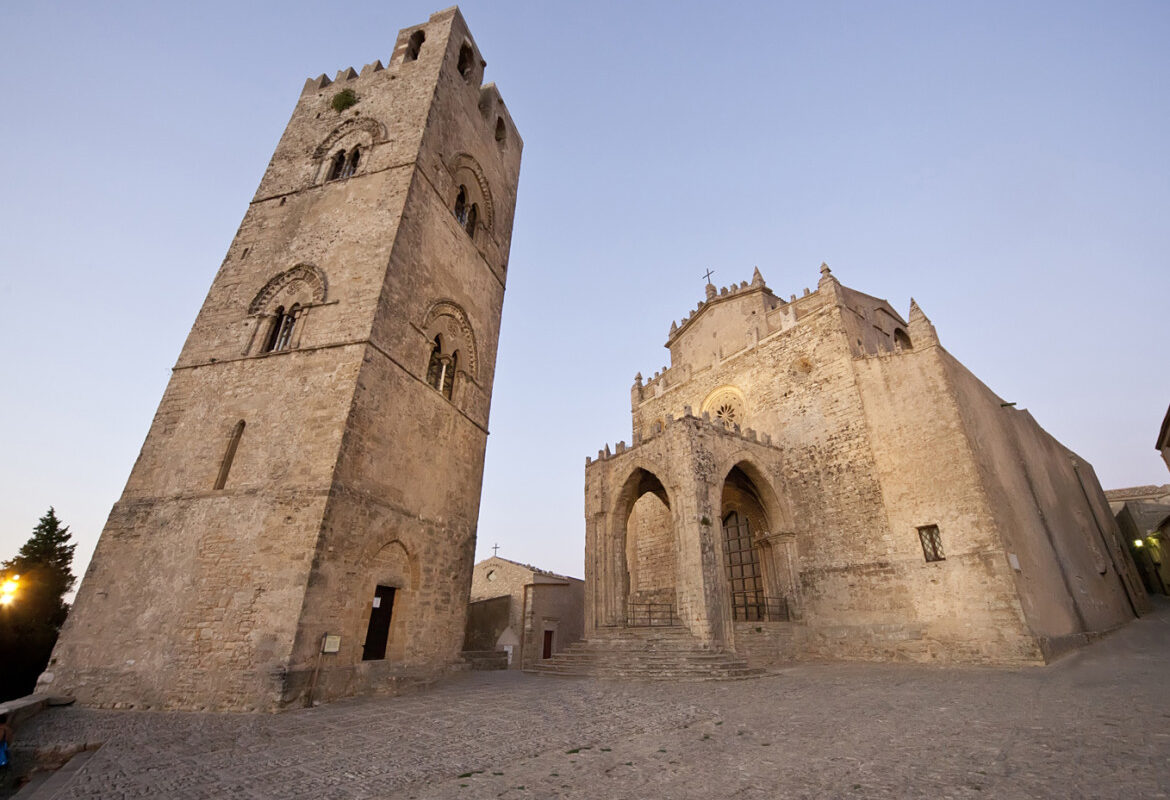
The Mother Church was built in the early fourteenth century (c.1314) on a pre-existing chapel dedicated to the Virgin of the Assumption, at the wish of Frederick III of Aragon who resided in Erice for a short time during the War of the Vespers. After various restorations, additions and alterations over the centuries, it was radically renewed in the second half of the nineteenth century, and took on its present Neo-Gothic appearance, given to it by the Neapolitan architect Dominici between 1852 and 1862. Of the ancient building there remain: the three-nave plan, the columns supporting pointed arches, four sixteenth-century chapels.
The façade keeps its original forms in the Chiaramonte pointed portal with zig-zag decorations: the porch is a fifteenth-century addition, the staircase is from 1769, the rose window was made in 1954. Set into the outer wall, south side, are nine Greek crosses, coming, according to tradition, from the temple of Venus; on the north wall of the building there is also a Catalan portal decorated with diamond-point ashlars.
Inside are kept fine sculptures of the fifteenth and sixteenth centuries, including the marble statue depicting a Madonna and Child (15th century), reproducing the Madonna of Trapani, attributed now to Francesco Laurana, now to Domenico Gagini, and the large marble icon with the Madonna enthroned with the Child at the centre, dated 1513, attributed to the Carrara sculptor Giuliano Mancino.
In the left nave three sixteenth-century chapels, linked together almost to form a single space, now house the Treasury of the Mother Church, consisting of silver liturgical objects, including: a reliquary by Pietro Lazzara, a statue of Saint Anthony Abbot by the Trapani artist Pietro Orlando (1699), sculptures and paintings from suppressed Erice churches and monasteries, sacred vestments and altar frontals.
Next to the church rises the tall bell tower (28 m), built as a watchtower at the time of the War of the Vespers, towards the end of the thirteenth century, then turned into a bell tower. It has a square base (8 m per side) and develops over three floors, each occupied by a barrel-vaulted room. Single-light windows (on the first floor) and Gothic-Chiaramonte-style mullioned windows open in it; it was also used as a prison of the ecclesiastical court. A staircase of 113 steps leads to the top.