Place of interest
Giudecca or Palazzo Ciambra
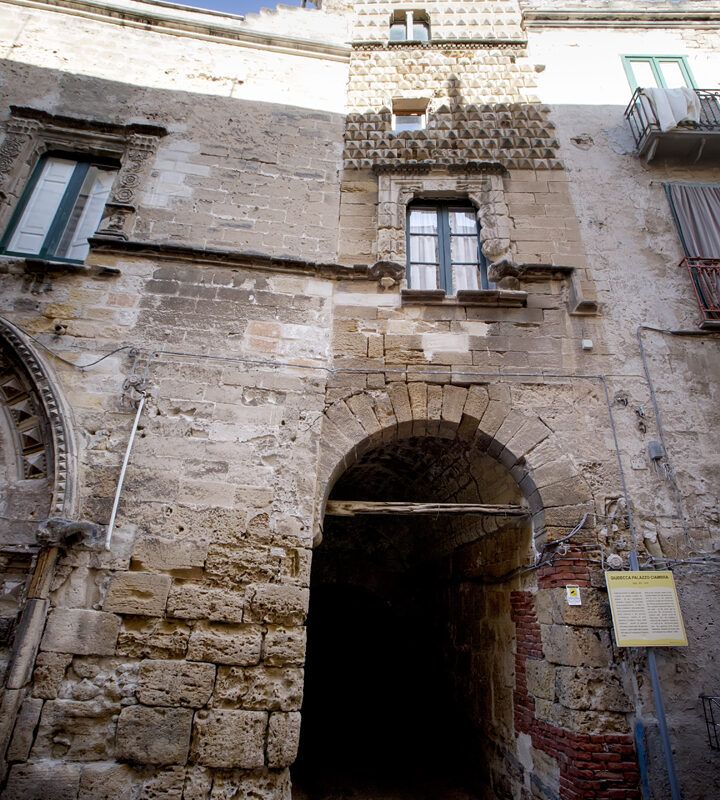
The Palazzo della Giudecca, so called for its location in the city’s ancient Jewish quarter, was built in the first decades of the sixteenth century by the Ciambra family, whose coat of arms depicting a deer at the foot of a tree is set in the pointed entrance portal.
Trapani
The place
The Palazzo della Giudecca, so called for its location in the city’s ancient Jewish quarter, was built in the first decades of the sixteenth century by the Ciambra family, whose coat of arms depicting a deer at the foot of a tree is set in the pointed entrance portal.
It is a two-storey building, with a side tower completely covered in diamond-point ashlars, the so-called Spanish picos, with a characteristic crowning of brackets and small arches. On the façade, made of exposed squared ashlars, the portal opens on the ground floor, with an archivolt decorated with diamond points and saw-teeth.
On various levels there are windows enriched with minute decoration and carvings of fine workmanship derived from the Spanish custom of chiselling silver (plateresque).
The Giudecca, together with the Steripinto of Sciacca, is the most significant example of sixteenth-century Sicilian architecture, since in it Gothic (pointed arch), Renaissance (architraved windows) and plateresque (picos and window decoration) elements merge.
Through a large arch and a gallery you enter the inner courtyard, where remains of the original building still emerge, including an architraved window.
Alterations, restorations and tampering have unfortunately changed the original layout of the building: the entrance portal and some windows have been walled up and altered, the interior rooms readapted for residential use.