Place of interest
Palazzo Senatorio
Placed where Via Torrearsa (formerly Via degli Scultori) crosses Corso Vittorio Emanuele (formerly Rua Grande), the Palazzo Senatorio was built on the site where the ancient Pisani Loggia stood, which is why, even today, the space in front is called Loggia.
Trapani
The place
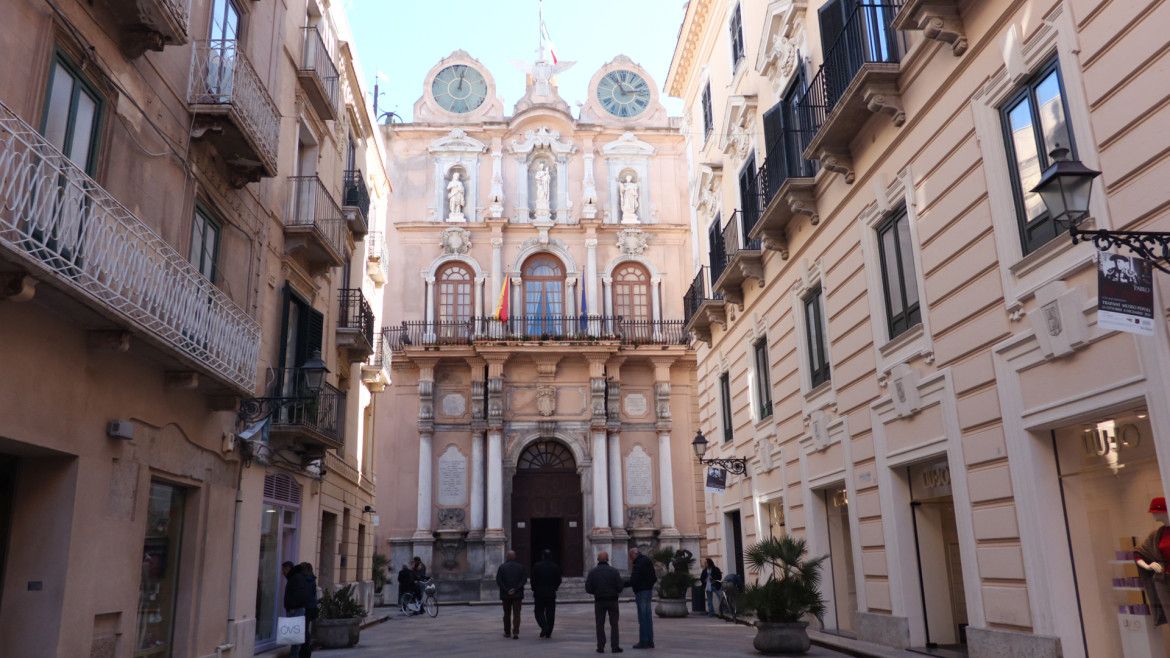
Placed where Via Torrearsa (formerly Via degli Scultori) crosses Corso Vittorio Emanuele (formerly Rua Grande), the Palazzo Senatorio was built on the site where the ancient Pisani Loggia stood, which is why, even today, the space in front is called Loggia.
Its origins date back to the fifteenth century but the radical renovation took place in the second half of the seventeenth century.
The façade, completed in the early years of the eighteenth century, was built at the expense of the Knight of Malta Giacomo Cavarretta, to a design by the architect Andrea Palma, who was obliged to respect the width of the Rua Grande, for which the palace’s Baroque façade had to act as a scenic backdrop.
It develops over three orders: the last holds three niches with the statues of the Madonna of Trapani (in the centre), of Saint Albert and Saint John the Baptist (at the sides), works by Giuseppe Nolfo who made them between 1701 and 1702.
The two boxes containing a clock and a date-dial, placed at the sides of the royal eagle, were added in 1827. Adjoining the palace is the former Porta Oscura with the so-called clock tower.