Place of interest
The Misteri of Trapani
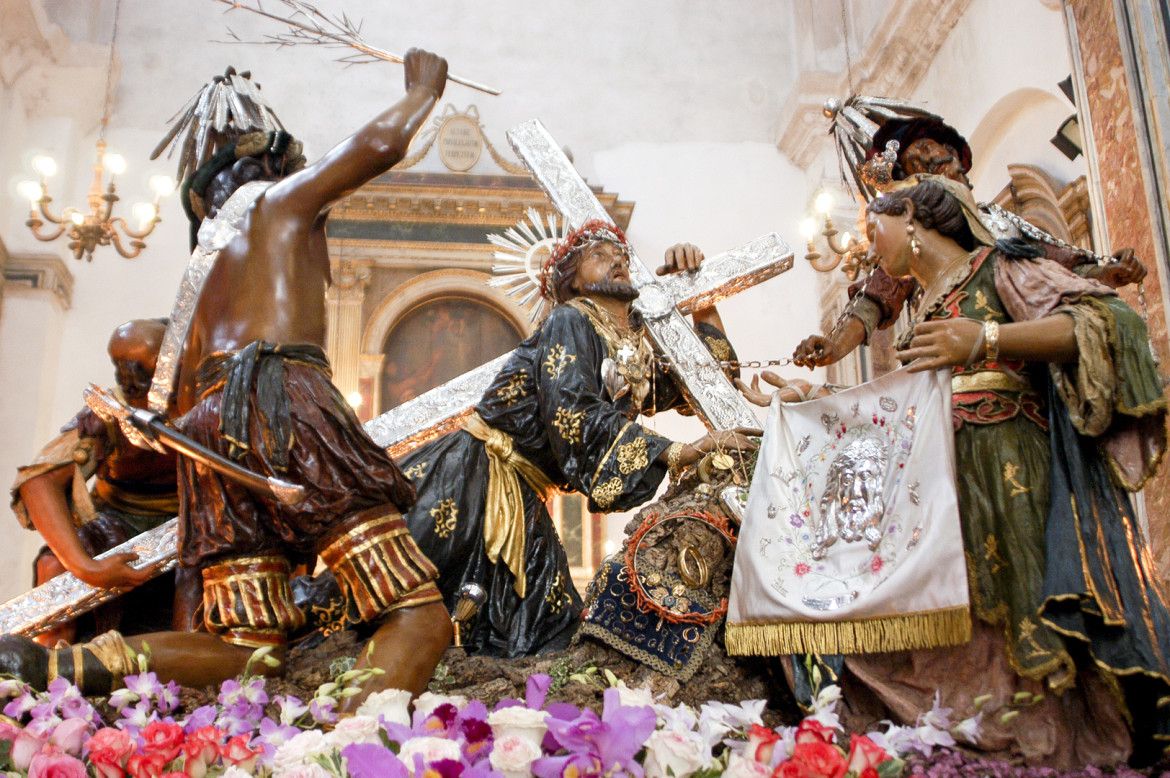
In Trapani at the end of the sixteenth century and the beginning of the seventeenth, thanks to the Society of the Blood of Christ, later merged with the Confraternity of San Michele (1646), the Misteri arose, statue groups depicting episodes of the Passion of Christ. This was helped by the strict provisions of the Council…
Trapani
The place
In Trapani at the end of the sixteenth century and the beginning of the seventeenth, thanks to the Society of the Blood of Christ, later merged with the Confraternity of San Michele (1646), the Misteri arose, statue groups depicting episodes of the Passion of Christ. This was helped by the strict provisions of the Council of Trent and by the arrival in Trapani of the Jesuit fathers who had included the penitential mission in their catechesis programme, with the aim of evangelising the humblest classes, also through spectacular elements such as processions and ceremonies, apt to arouse religious piety and compunction. The care and the parade of the sacred groups were in fact entrusted to the craft guilds.
The technique used to make the Trapani statues is the so-called wood, cloth and glue technique, consisting in carefully carving in wood the faces, hands, feet and visible parts of the body, which are then applied to a chestnut-wood structure covered with cork in order to give volume without increasing weight. The garments are made of cloth soaked in plaster and animal glue, and draped in soft folds.
The sculptural groups that make up the present procession are, for the most part, eighteenth-century works, the result of remakings of the originals of the first processions.
Handwritten sources and local historiography have handed down the names of some sculptors: Giuseppe Milanti (1658- ?), Giacomo Tartaglio (1678-1751), Mario Ciotta (late 17th century-c.1750), Antonio Nolfo (1698-1778), Baldassare Pisciotta (1715-1792), Domenico Nolfo (1730-1782), Francesco Nolfo (1741-1809), Domenico Li Muli (1902-2003). Reconstructions, restorations, tampering and changes made over the centuries have altered the originality of the works. Recent interventions have consolidated the statues and given them back their original colours.