Place of interest
Trapani Coral
The history of Trapani coral has very distant origins, and as early as the twelfth century the Arab traveller Idrisi noted its prized quality. In the fourteenth century the discovery of a coral “mine” in the sea of Trapani (1416-1418) and near San Vito Lo Capo (1439) drew to the city some…
Trapani
The place
The history of Trapani coral has very distant origins, and as early as the twelfth century the Arab traveller Idrisi noted its prized quality. In the fourteenth century the discovery of a coral “mine” in the sea of Trapani (1416-1418) and near San Vito Lo Capo (1439) drew to the city some Jewish families from the Maghreb who made a considerable contribution to its working, from cleaning to the making of little spheres, olive-shaped beads, small studs or commas.
The finding of other coral banks between 1530 and 1535, at Tabarka, led to an increase in the production of artefacts and above all in their trade on the various markets of Italy.
Around coral orbited three categories of workers: the fishermen, called corallai, the master coral workers (corallari), and the sculptors.
The first only fished the red material and sold it to the coral workers who cleaned it, removing the orange patina (coenosarc) with iron scrapers and millstone, cut it with pincers and worked it with the file and the stone wheel, until reducing it to small elements or little spheres that were drilled with the fusellino (small drill), to be then used for making necklaces, bracelets and rosaries. The sculptors had the task of working the thicker branches to create, with the burin and the chisel, small sculptures or cameos of high artistic value; they were however obliged to subordinate their creativity to the branch and to work “in miniature”.
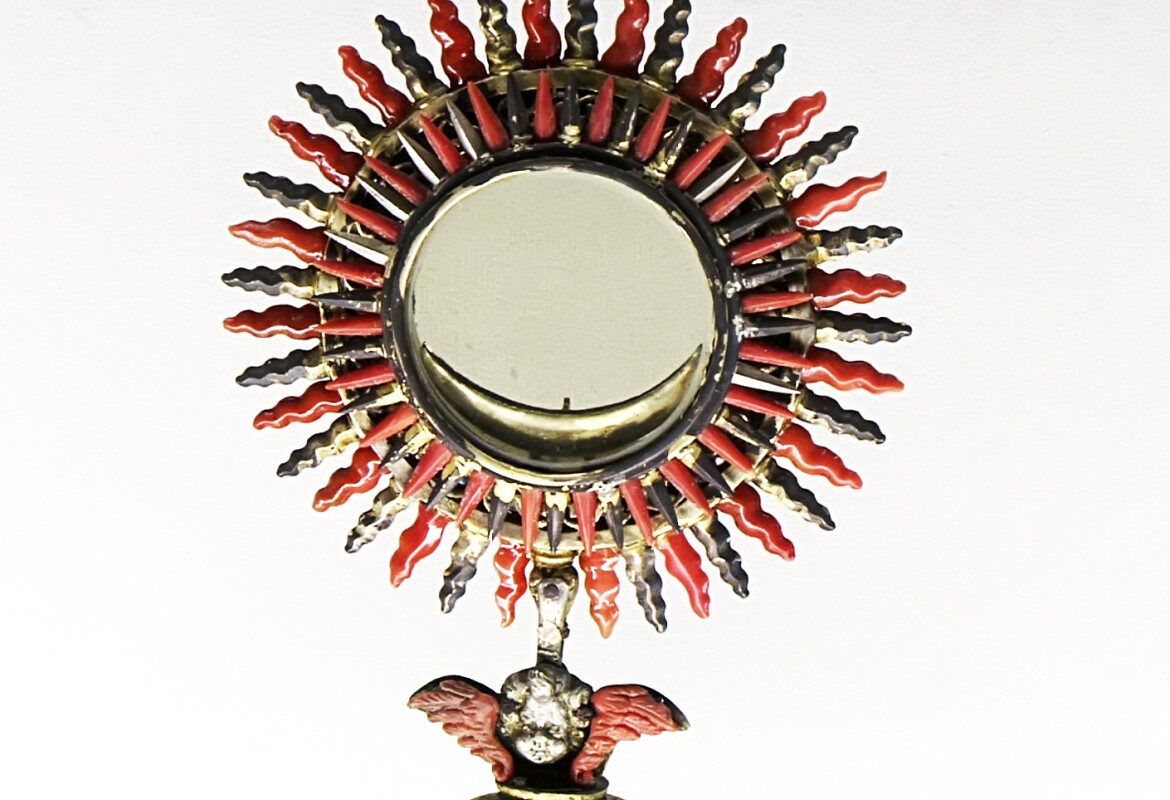
The oldest technique for applying pods, commas, dots and tongues of coral onto previously pierced copper is the rear-setting (retroincastro), consisting in fixing the small coral elements from behind with a special glue made of pitch, wax and cloth, and then covering (again the back) with another copper plate, often decorated with engravings and punch marks.
The surfaces of the objects were entirely filled with coral, repeating an ancient Arab-Islamic custom of decorating “carpet-style”, a sort of horror vacui, well suited to the taste of the time.
At the end of the seventeenth century the Trapani masters changed the technique of application on copper, replacing rear-setting with sewing through metal wires and small pins.
When, at the end of the eighteenth century, the first symptoms of the decline of the red material began to be felt because of the disappearance of the coral banks, the Trapani art of coral entered decline: the sculptors continued to use it by combining it with other materials, then fell back definitively on ivory, bone, mother-of-pearl, alabaster and hard stones, thus renewing the ancient art with other materials and other artefacts.